Thinking
Architecture usually talks about resilience as resistance.
Can the roof withstand the wind? Is the floor above the flood level? Will the structure remain standing?
Those questions matter.
But for the person who lives there, the consequence of a disaster continues long after the event has passed.
A house can remain structurally intact and still be uninhabitable for months. Materials can trap contamination. Electrical services can be destroyed. Joinery can need complete replacement. Insurance claims can take time. Builders and materials can be difficult to secure when thousands of households need them at once.
The difference between surviving an event and recovering from it is substantial.
Recent Australian evidence makes that distinction increasingly important.
Insurance is becoming part of the housing problem
In March 2026, the Australian Prudential Regulation Authority released a climate vulnerability stress test developed with the country’s five largest general insurers.
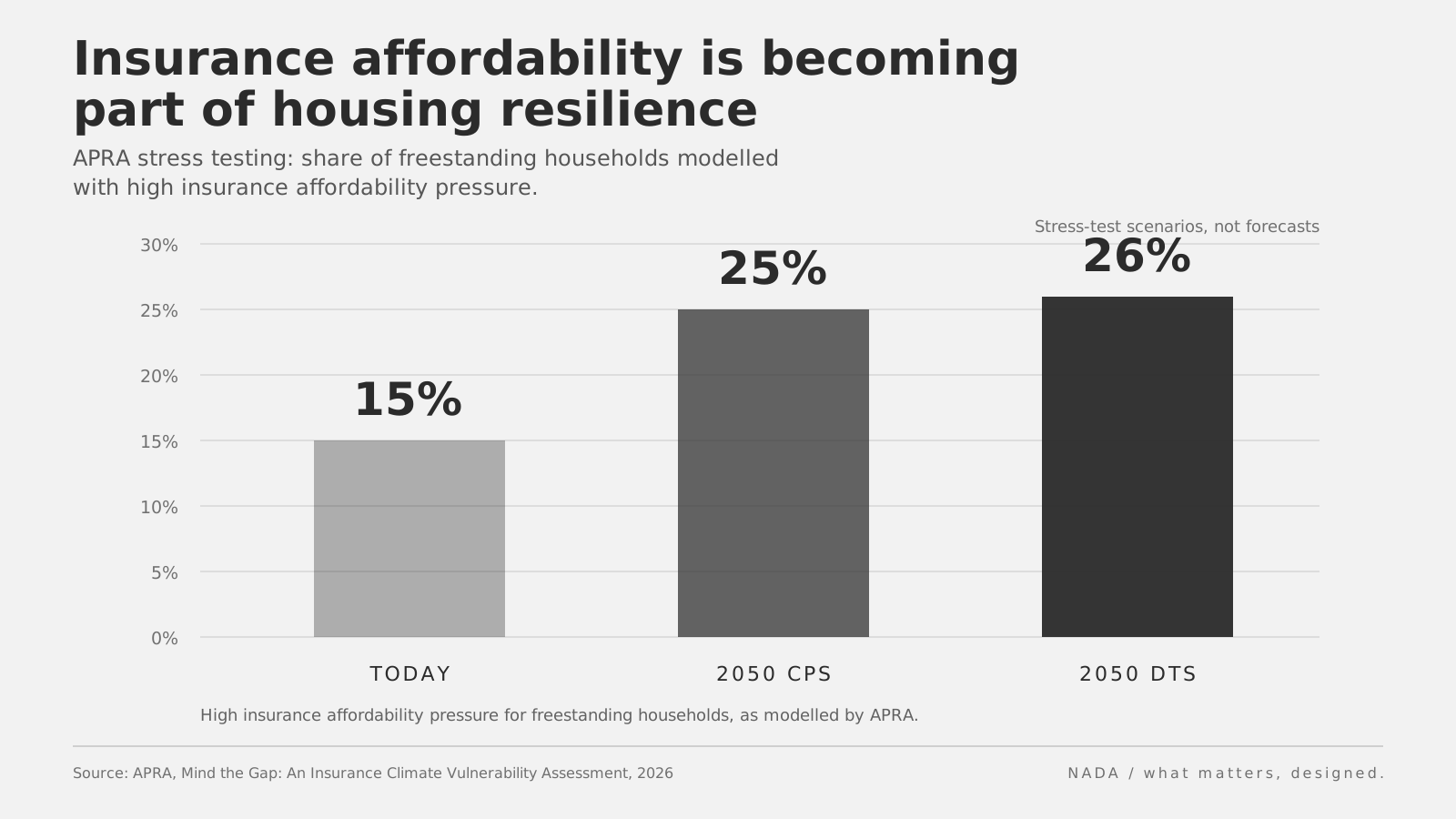
APRA estimates that around 15 per cent of households in freestanding homes currently face high insurance affordability pressure. Under both of the severe-but-plausible scenarios it tested, that figure rises to roughly one quarter by 2050.
These scenarios are not forecasts. APRA is explicit about that.
Their value is in showing the pressures that can widen the protection gap. In one scenario, increasing weather losses dominate. In the other, construction costs become a major driver because higher rebuild costs feed directly into premiums.
New South Wales and Queensland are particularly exposed. In APRA’s modelling, their protection gaps rise from below 20 per cent today to above 30 per cent by 2050 under both scenarios.
That turns something architects often treat as a financial issue into a design question.
A home is not genuinely resilient if the cost of repairing or insuring it makes recovery unrealistic.
Design for the day after
Queensland already has practical evidence of what this means.
Following the 2022 floods, surveys of 70 owners whose homes had previously received flood-resilience work found 45 reporting that the measures had succeeded. Some households were able to wash out, dry out and return within days; others within weeks. Nearby households faced reconstruction periods extending beyond 18 months.
The interventions are often remarkably ordinary.
Raise electrical services. Choose materials that tolerate wetting. Design wall assemblies so they can be cleaned and dried. Avoid cavities that trap contaminated water. Put vulnerable equipment above likely flood levels. Make lower-level components removable or replaceable rather than requiring the destruction of the whole assembly.
None of these decisions stops the flood.
They change what the flood does to the building.
That is a different definition of resilience.
The Queensland Reconstruction Authority describes flood-resilient design in similar terms: reduce damage, reduce disruption and allow a home to be safely reoccupied sooner.
The same thinking extends beyond flooding.
Cyclone research from James Cook University’s Cyclone Testing Station has used insurance claims from Cyclones Larry and Yasi to identify building characteristics associated with losses and to inform retrofit strategies. In bushfire-prone areas, recoverability may involve access, separation, material exposure and the ability to replace damaged components without losing the entire building.
The hazard changes.
The underlying question remains: what happens after impact?
Repairability is a design quality
Architecture spends a great deal of effort deciding how things go together.
We spend much less time asking how they come apart.
That matters because a building assembled as one inseparable object can make small areas of damage disproportionately expensive to repair.
If a flooded cabinet requires the destruction of the wall behind it, or a damaged façade system cannot be accessed without removing adjoining work, the architecture has amplified the consequence of the event.
Designing for repairability means thinking about replacement before replacement is needed.
Which elements are likely to be exposed first? Can vulnerable components be separated from long-lived ones? Can wet materials dry? Can services be reached? Can damaged parts be removed without destroying everything around them? Are replacement materials likely to remain available?
These are not only disaster questions.
They are questions about maintenance, ageing and the next life of the building.
Insurance does not need to become the design brief
There is a risk of taking this argument too far.
Insurance pricing is complex. Premiums reflect reinsurance, location, hazard models, construction costs, claims history, taxes and business decisions as well as the physical characteristics of the home. A particular design decision will not necessarily result in a particular premium reduction.
Architecture should not be reduced to satisfying an insurer.
But insurance can reveal something useful about consequence.
If the likely cost of loss is rising, then reducing the amount of building that must be replaced after an event becomes valuable even when the premium never changes.
A family returning home in two weeks rather than eighteen months experiences that value very directly.
So perhaps resilience needs to be considered across three moments.
Before an event: reduce exposure where possible.
During it: protect life and limit damage.
After it: make recovery achievable.
The third is often the least visible during design, because nothing has gone wrong yet.
It may be the part that matters most afterwards.
What does the building allow people to do next?
A resilient house does not have to be indestructible.
Trying to eliminate every possible failure can add cost, material and complexity without necessarily improving the outcome.
A more useful ambition may be to control the consequence of failure.
Some components can be sacrificial. Others can be protected. Some materials can get wet and recover. Services can be moved. Parts can be designed to come away without taking the whole building with them.
The aim is not a building that cannot be damaged.
It is a building in which damage does not automatically become catastrophe.
That leads to a different question for architects and clients:
If something happens to this house, what will it take to live here again?
The answer belongs in the design long before the event occurs.
Sources
APRA (2026), Mind the Gap: An Insurance Climate Vulnerability Assessment: https://www.apra.gov.au/news-and-publications/mind-gap-insurance-climate-vulnerability-assessment
Queensland Reconstruction Authority, Flood Resilient Building Guidance for Queensland Homes: https://www.qra.qld.gov.au/resilient-homes/flood-resilient-building-guidance-queensland-homes
Queensland Reconstruction Authority, Real-time test validates decade of flood resilience design work: https://www.qra.qld.gov.au/news-case-studies/case-studies/real-time-test-validates-decade-flood-resilience-design-work
Queensland Reconstruction Authority, Enhanced Design Guidance for Flood Resilient Homes (2026): https://www.qra.qld.gov.au/news-case-studies/news/enhanced-design-guidance-flood-resilient-homes
James Cook University Cyclone Testing Station, Insurance Claims Data Analysis for Cyclones Yasi and Larry: https://researchonline.jcu.edu.au/45863/