Thinking

Australian houses are changing.
Better windows, more insulation, membranes and improved construction are reducing the amount of air that slips through the envelope. That is generally a good thing. Uncontrolled leakage brings heat, humidity, noise, smoke and pollutants with it, and it makes a building harder to understand and control.
But better construction creates a new responsibility.
If we reduce accidental air movement, we also need to decide deliberately how fresh air enters the house and how stale, humid air leaves it.
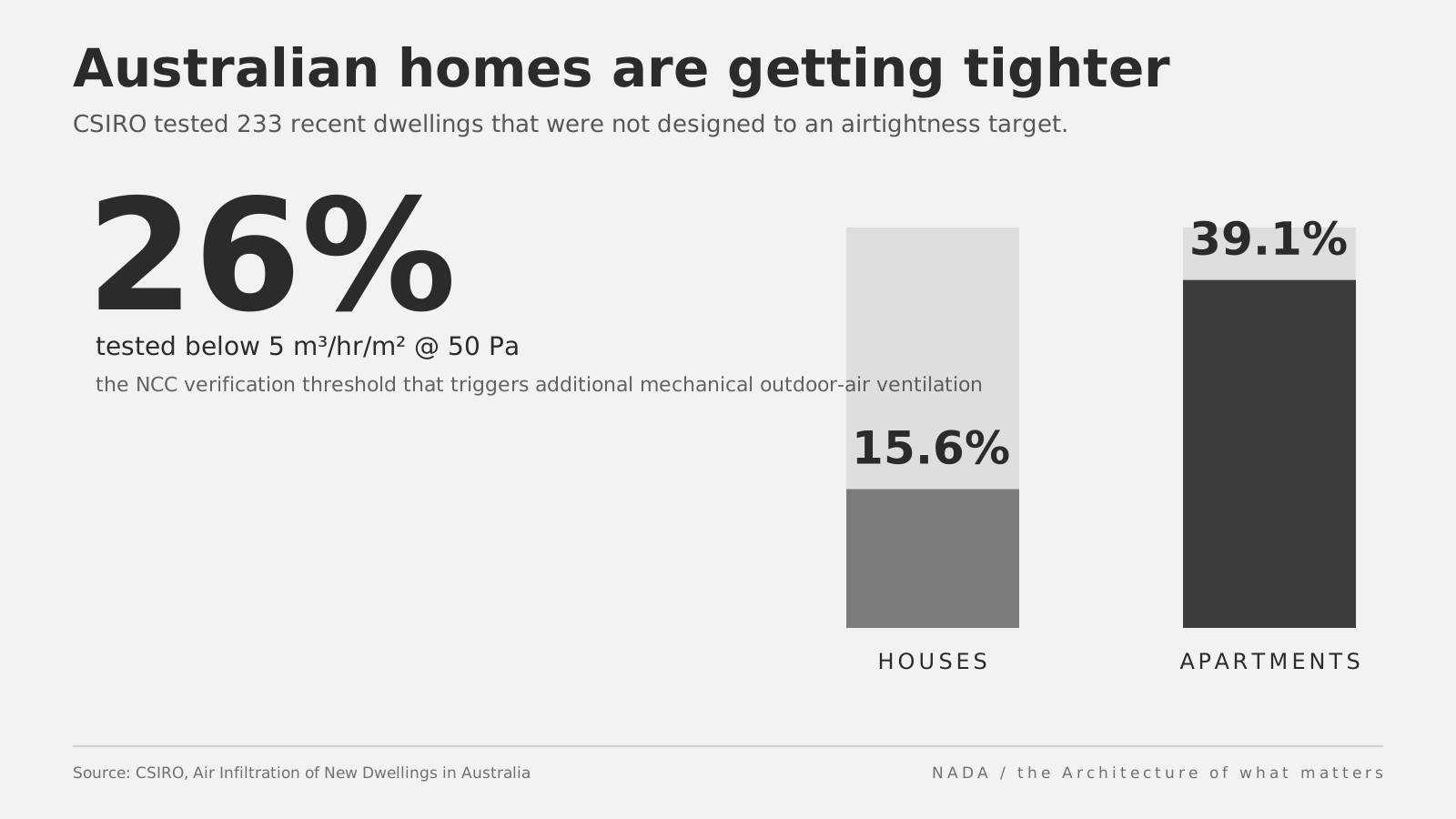
CSIRO recently tested 233 new Australian dwellings that had not been designed to an airtightness target. About 26 per cent were tighter than 5 m³/hr/m² at 50 Pa, including 15.6 per cent of houses and 39.1 per cent of apartments. CSIRO noted that these homes were not aiming for a particular permeability, so the corresponding ventilation had not been designed around the measured result.
That matters because the National Construction Code already recognises a point at which airtightness changes the ventilation question. Under its building-envelope verification pathway, a dwelling measuring 5 m³/hr/m² at 50 Pa or tighter requires additional mechanical outdoor-air ventilation.
The difficulty is that most homes are never measured.
Under the usual NatHERS pathway, a new dwelling is assumed to have an air permeability of 10 m³/hr/m² at 50 Pa. The finished building may be leakier or substantially tighter. Unless it is tested, we do not really know.
Is NatHERS still enough?
NatHERS has been important in lifting the thermal performance of Australian housing. A common assessment allows designs to be compared and minimum standards to improve.
But it answers a particular question.
NatHERS estimates heating and cooling demand under standardised assumptions. It does not, on its own, establish long-term thermal safety, indoor air quality, moisture resilience or comfort under future climate conditions.
That does not make NatHERS a bad tool. It means the information it provides may no longer be sufficient for every decision we expect it to support.
As envelopes improve, the relationships between air, heat and moisture become more deliberate. Knowing the star rating without knowing what was actually built tells us only part of the story.
This is where Passivhaus becomes interesting — not necessarily as a target, but as a way of thinking.
The Passive House Institute treats airtightness and controlled ventilation as separate but connected parts of the same building system. Its standards combine a very tight envelope with measured ventilation rates and quality assurance. The important principle is not that every Australian home should meet the Passivhaus airtightness limit. It is that the air occupants need should not depend on construction defects.
A crack around a window is not a fresh-air strategy. Neither is a downlight penetration, an unsealed service or a gap at a skirting board. We do not know how much air will come through them, where it has been, or whether it will arrive when we need it.
Open when it makes sense. Closed when it does not.
A warm-humid Australian house does not need to behave like a permanently sealed box.
When outside conditions are favourable, it can open properly. Shaded windows and doors, useful cross-ventilation, ceiling fans and outdoor rooms can provide comfort with very little energy. That remains one of the great opportunities of subtropical architecture.
But there are also times when opening the house is not advantageous.
The air may be hot and humid. There may be bushfire smoke, traffic noise, heavy rain, mosquitoes or no useful breeze. Occupants may need security while sleeping. At those times the same building can close.
The question then becomes simple:
Where does the fresh air come from when the house is closed?
A controlled system can supply known quantities of filtered outdoor air and extract air where moisture and pollutants are generated. In a humid climate, heat or energy recovery may reduce the outdoor moisture load, but it does not automatically eliminate the need for active dehumidification. The appropriate system depends on the building, climate, occupancy and how the house is intended to operate.
This suggests a different model for high-performance housing in south-east Queensland: not naturally ventilated or airtight, but deliberately capable of both.
The open state should be designed properly.
So should the closed state.
Measure what was built
This leads to a very practical proposition.
If the airtightness of a house materially affects its ventilation strategy, perhaps airtightness should be measured more often.
A blower-door test does not turn a house into a Passivhaus. It simply replaces an assumption with information.
Once we know how the completed envelope behaves, we can make a more informed decision about ventilation, filtration, humidity control and commissioning. We can also identify unintended leakage while it is still possible to fix it.
The larger point is not about adopting another standard.
It is about having enough understanding to make the right decision for the building in front of us.
As Australian housing becomes better insulated and better sealed, relying on accidental leakage becomes increasingly difficult to justify. The most transferable lesson from Passivhaus may therefore be simpler than its most famous number.
Fresh air should be designed, not left to the gaps.
Sources
CSIRO, Air Infiltration of New Dwellings in Australia: https://www.nathers.gov.au/sites/default/files/2025-10/CSIRO%20Air%20Infiltration%20of%20New%20Dwellings%20in%20Australia%20Report.pdf
Australian Government, YourHome, Ventilation and airtightness: https://www.yourhome.gov.au/passive-design/ventilation-airtightness
National Construction Code 2022, H6V3 Verification of building envelope sealing: https://ncc.abcb.gov.au/editions/ncc-2022/adopted/volume-two/h-class-1-and-10-buildings/part-h6-energy-efficiency
Passive House Institute, Building certification / criteria: https://passivehouse.com/en/home/building-certification/
Guan et al. (2026), Investigating the effects of intermittent indoor temperature control on hygrothermal risks in energy-efficient homes: https://doi.org/10.1016/j.enbuild.2026.117380
Guan et al. (2026), An evaluation of hygrothermal risks associated with intermittent conditioning in energy-efficient Australian homes: https://doi.org/10.1016/j.buildenv.2026.114700