Thinking

When we talk about how a house performs in hot weather, the obvious number is usually the maximum temperature.
How hot does it get?
It is an understandable question. But it may not be the only one that matters.
A house absorbs heat throughout the day. Sun strikes the roof, walls and windows. Materials warm. Outside temperatures rise. Appliances and people add more heat internally.
Eventually the sun goes down.
What happens next may be just as important.
Does the house release that accumulated heat and become cooler overnight?
Or does the bedroom remain warm while its occupants try to sleep?
New research from southeast Queensland gives us an unusually direct look at why that distinction matters.
What happens in a real bedroom?
Researchers monitored 47 people aged 65 and over in their own homes across the summer of 2024–25.
Temperature sensors recorded conditions inside their bedrooms. Wearable devices simultaneously measured heart rate and heart-rate variability while they slept.
Across more than 14,000 hours of valid night-time observations, the median bedroom temperature was 25.9°C.
The physiological pattern changed as bedrooms became warmer.
Compared with temperatures below 24°C, bedrooms between 24 and 26°C were associated with greater odds of a clinically relevant change in one important measure of heart-rate variability.
Between 26 and 28°C, the association became stronger.
Between 28 and 32°C, stronger again.
Heart rate also increased with higher bedroom temperatures.
The researchers interpret these changes as evidence of greater physiological stress and reduced autonomic recovery as night-time temperatures rise.
In simple terms, the body appears to be working harder when it should be recovering.
This does not make 24°C a magic number
There is an important distinction here.
The research does not prove that sleeping in a room above 24°C causes heart disease.
It does not establish a universal temperature at which a bedroom suddenly becomes unsafe.
And the study involved older adults, a group known to be particularly vulnerable to heat. We should not automatically assume identical effects in every age group.
What the research provides is something more useful than a simplistic threshold.
It shows a progressively stronger physiological response as bedroom temperatures increase in real homes, during a real southeast Queensland summer.
That gives us reason to think differently about what good thermal performance means.
Buildings need to recover too
Much of Australia's discussion about residential energy performance focuses on heating and cooling demand.
That is useful. Reducing the amount of energy required to keep a house comfortable matters.
But energy demand and thermal resilience are not quite the same thing.
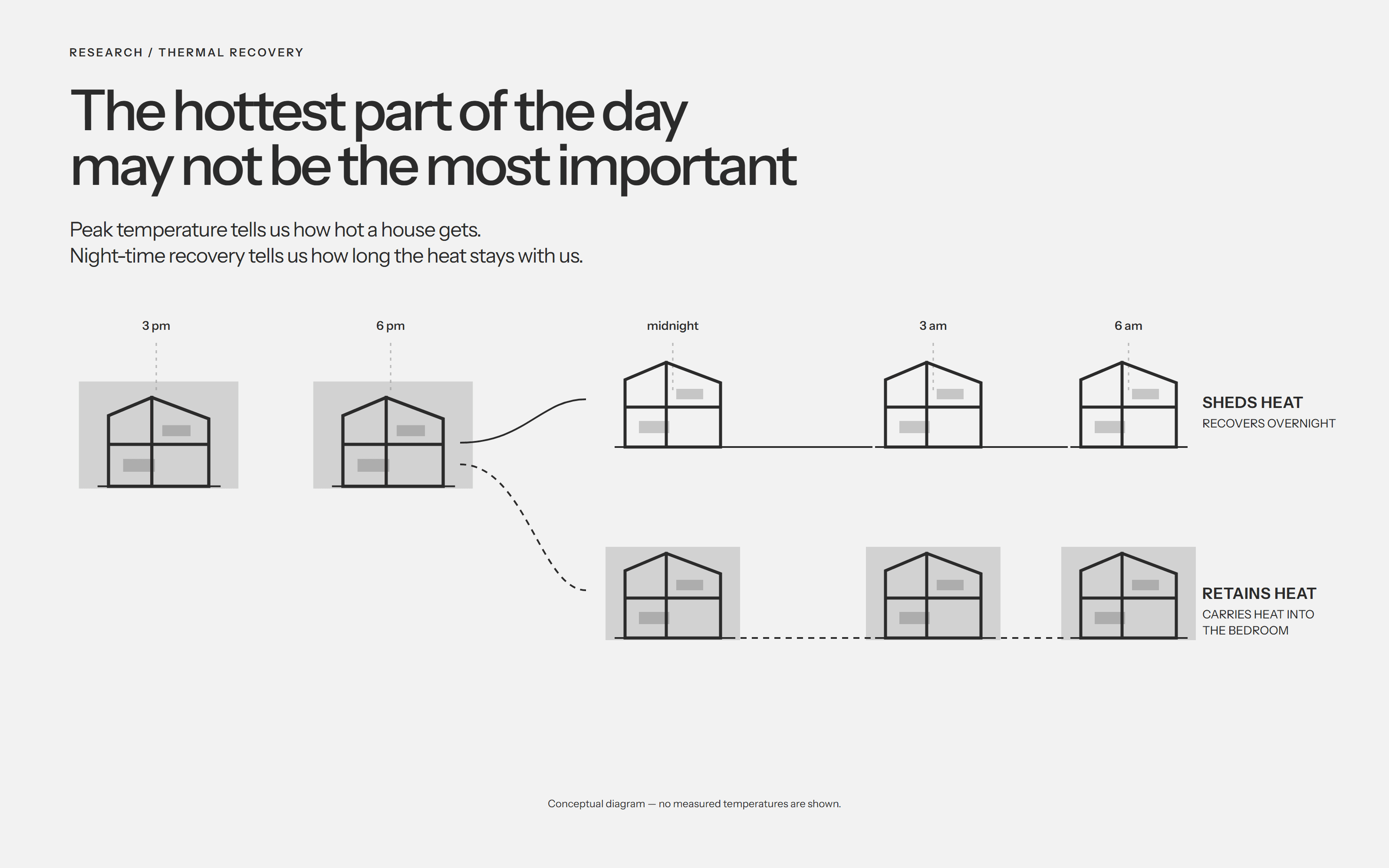
Imagine two houses experiencing the same hot day.
Both reach similar maximum temperatures.
After sunset, one begins cooling quickly. Shaded external surfaces stop receiving heat. Cooler air can move through the building. Ceiling fans increase air movement. Bedrooms shed the heat accumulated during the afternoon.
The other remains warm deep into the night.
Their daytime maximum may have been similar.
Their consequences for the people sleeping inside may be quite different.
That suggests another performance question worth asking:
How quickly can the house recover after a hot day?
The bedroom deserves particular attention
Bedrooms are unusual spaces.
We spend a large continuous part of every day in them, but generally while producing little movement and having fewer behavioural options available to us.
During the day, someone who feels hot might move outside, change rooms, open a door, take a shower or seek an air-conditioned place.
At 2 am, the useful options become narrower.
That makes bedroom design consequential.
Orientation matters. So does western solar exposure. Roof construction matters. External shading matters. The ability to purge accumulated heat when outdoor conditions become favourable matters.
And in warm, humid climates, simply opening a window may not always solve the problem.
The outside air may remain hot. Humidity may be high. There may be no breeze. Noise, smoke, insects, security or heavy rain may make open windows impractical.
A resilient bedroom therefore needs more than one way of remaining habitable.
What about ceiling fans?
There is encouraging evidence here too, but with an important qualification.
In another recent experiment, researchers exposed 20 older adults to indoor conditions of 31°C and 45 per cent relative humidity for eight hours.
Participants experienced the conditions both with and without a ceiling fan.
The fan helped.
Peak core body temperature was lower. Heart-rate response and thermal discomfort were reduced.
But the fan did not eliminate the physiological effects of prolonged heat exposure.
The researchers therefore describe a fan-first approach rather than a fan-only approach.
That is a useful distinction for architecture.
Ceiling fans use very little energy and can substantially extend the conditions in which people remain comfortable. They deserve to be designed into warm-climate homes properly rather than treated as an appliance added afterwards.
But air movement cannot remove unlimited heat from a building.
Eventually the heat itself needs somewhere to go.

A different way to think about summer
For much of the year, good warm-climate design can make outside conditions an asset.
Shade the sun.
Open the house.
Catch useful breezes.
Move air across the body.
Allow accumulated heat to escape when outside temperatures fall.
Those remain excellent strategies.
The problem arises when the outside environment stops providing the conditions on which those strategies depend.
A hot night following a hot day is different from a hot afternoon followed by a cool evening.
Several hot days and nights in succession are different again.
The house begins each day carrying some of yesterday's heat with it.
That is why future climate resilience cannot be understood only through maximum temperature.
Duration matters.
Humidity matters.
Night-time temperature matters.
And the sequence of one hot day after another matters.
Designing for sleep
None of this necessarily means air-conditioning an entire house throughout summer.
In fact, it suggests the opposite may sometimes be possible.
If sleeping conditions are particularly important, there is value in thinking deliberately about bedrooms as part of a home's thermal strategy.
Could sleeping spaces be positioned away from severe western exposure?
Can external shading prevent unnecessary heat entering in the first place?
Can the building release heat effectively when evening conditions permit?
Are ceiling fans properly located and sized?
Can bedrooms be separated into a smaller conditioned zone during extreme weather rather than cooling the whole house?
And if windows need to remain closed, what happens to ventilation and humidity?
These are not questions about adding equipment.
They are questions about understanding what the building needs to do at different times.
Perhaps we are measuring the wrong moment
The hottest temperature reached inside a house is useful information.
So is annual heating and cooling demand.
But neither completely describes what it feels like to live through a hot summer.
A house is occupied continuously.
Our bodies experience the sequence.
Day follows night. One hot day follows another. The opportunity to recover matters.
The southeast Queensland research does not yet tell us exactly what every bedroom temperature should be.
It tells us something more fundamental.
A home should not only protect us from the heat of the day. It should give us somewhere to recover from it at night.
SEO title: Hot Bedrooms and Home Design: Why Night-time Heat Matters
Meta description: Queensland research links warmer bedroom temperatures with greater physiological stress in older adults. What does that mean for designing homes for hotter nights?
Suggested URL slug: hot-bedrooms-night-time-heat-home-design
Editorial note: This gives clients a much more useful understanding of overheating than “keep the house cool”. It explains why bedroom location, shading, night cooling, fans, zoning and future climate need to be considered together, while being careful not to turn preliminary physiological evidence into a health prescription.